


Microsoft OneDrive
Microsoft Corporation
I use cloud storage for a very ordinary reason: I want my photos, documents, and work files to remain available when I change devices or something goes wrong with a phone. Microsoft OneDrive is built around that habit, but it feels more useful when treated as a working folder rather than just an emergency backup box. It can keep files accessible across devices, reduce the need to send attachments to myself, and make a mixed collection of personal and work documents easier to manage.
My experience with it is strongest when I already use Microsoft services or a Windows computer. The app is free to install, belongs to the productivity category, and comes from Microsoft Corporation. It has been available since August 28, 2012, and its Everyone age rating makes it approachable for a broad audience. The large user base is reflected in an average rating of 4.6 from around 7.1 million ratings, with more than 5 billion installs.
That popularity does not automatically make it the right cloud drive for everyone. OneDrive is convenient, familiar, and capable, but the best choice depends on how you organize files, which devices you use, and whether you need a generous free service or are comfortable paying for additional capacity. I found that its real value comes from the workflow around files, not from simply having another place to store them.
Related News

Google Assistant Shows How Mobile Productivity Is Changing

How Google Calendar is Transforming Mobile Productivity

How Microsoft OneDrive Redefines Mobile Productivity
How OneDrive fits into everyday file storage
A free starting point with optional paid purchases
OneDrive is free to download and use as an app. That matters because you can test its basic workflow without committing money first. The app also includes in-app purchases, listed from $0.99 to $129.99 per item. Those figures describe the purchase range shown for the app, not a promise that every user will need to pay or that one particular purchase suits every storage requirement.
I appreciate that distinction. A person who only wants to open shared documents, save occasional photos, or move files between a phone and a computer can begin without treating the app as a paid subscription decision. Someone who wants a larger long-term cloud library should examine the available purchase option carefully before spending, because the useful value depends on the amount of storage and services included with the specific choice.
Related News

Why WhatsApp Messenger Still Makes Everyday Communication Feel Easy

Jurassic World: The Game Is the Better Dino Tycoon for Strategic Players

Threads in Real Life: Who Should Join, Lurk, or Leave

How SHEIN Turned Shopping Into an Endless Content Feed

How to Make Fortnite Feel Smarter on Mobile

Should You Switch to Microsoft Outlook on Mobile?
The free access is therefore best understood as an entry point. It lets you learn whether the folder structure, upload behavior, sharing tools, and device access match your habits. If you dislike the way OneDrive handles your files, paying for more space will not solve that basic mismatch. I would install it first, organize a small group of real files, and only then decide whether a paid option makes sense.
What the app does well in a normal week
The central experience is simple: I place files in OneDrive, then open them from another device instead of carrying copies around manually. Photos can be kept with other personal files, while documents can be sorted into folders for work, study, household records, or travel. That sounds basic, but the benefit becomes clear when a phone is replaced or a laptop is unavailable.
A realistic example is preparing for a short trip. I can keep reservation documents, scanned identification copies, insurance paperwork, and a small set of offline-ready files in one location. Rather than searching through email attachments, I can open the same folder from my phone. The important habit is to prepare the folder before leaving and confirm that the files I need are available without relying on a weak connection.
Gallery
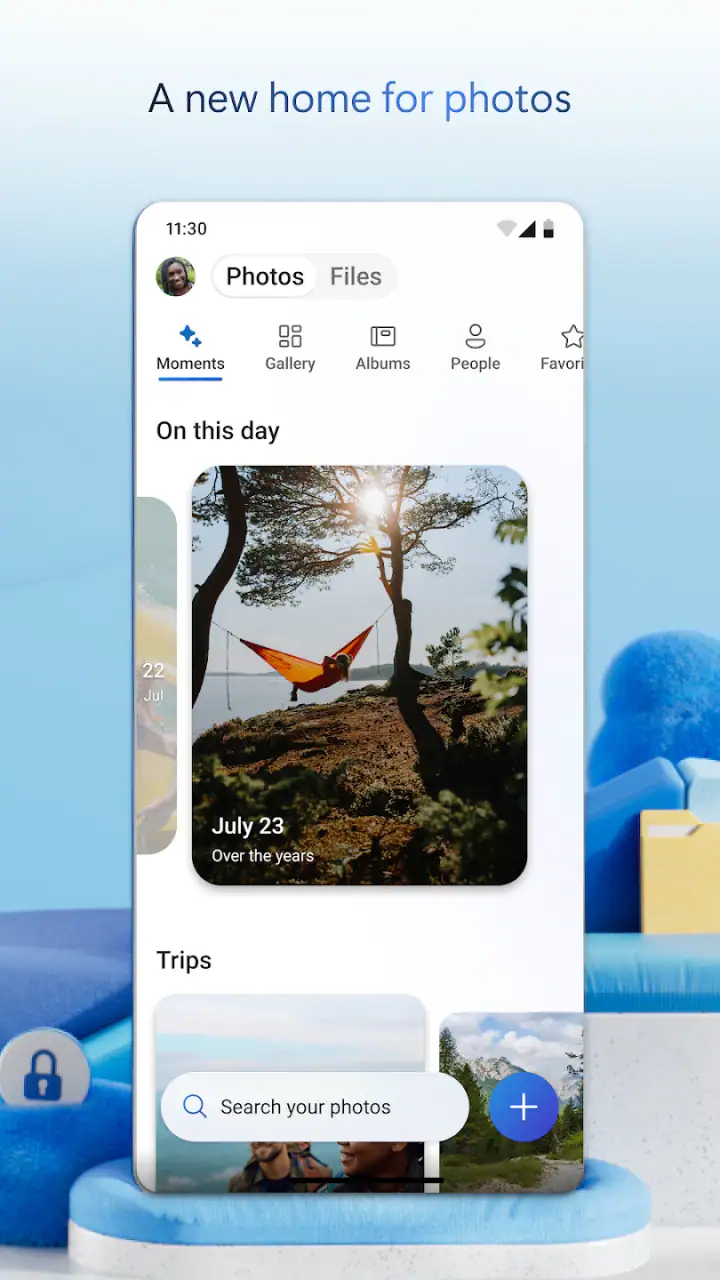
For work, I find OneDrive more useful when files are created on a computer and reviewed on a phone. A presentation, spreadsheet, or PDF can remain in the same broader file system instead of being duplicated through messaging apps. That reduces the familiar problem of editing one copy while accidentally sending an older version to someone else.
Useful workflows beyond simple backup
One of the less obvious strengths is the separation between accessing a file from the cloud and keeping a local copy on a device. I do not need every document stored permanently on my phone. For large folders, that can protect local space, while selected files can be made available when I know I will be offline. The trade-off is that I must think ahead; cloud availability is not the same as offline availability.
Another practical workflow is using folders as temporary handoff points. For example, I can create a folder for a household project, place receipts and reference documents there, and share that folder instead of repeatedly sending updated attachments. This is especially helpful when documents change over time. The recipient can return to the shared location rather than asking me to resend the newest version.
I also like using consistent file names before uploading. OneDrive can store a messy collection just as easily as a tidy one, so naming files with a date, subject, and clear version note makes the app much more effective. Cloud storage does not replace organization. In my experience, a modest folder system with deliberate names is more valuable than dumping everything into one camera or downloads folder.
For photos, the appeal is convenience: images can be kept accessible beyond the phone that captured them. Still, I would not treat a single cloud library as the only protection for irreplaceable memories. A second copy on another service or a separate physical drive is sensible for important material. OneDrive can be part of a backup routine, but relying on one location creates its own risk.
Where the Microsoft connection matters
The app makes the most sense for people already comfortable with Microsoft’s productivity environment. If your documents are commonly created or edited through Microsoft tools, keeping them in OneDrive can feel more natural than moving them between unrelated storage services. The benefit is less about a flashy feature and more about reducing friction between the places where files are created, stored, and reviewed.
That advantage is weaker if your household or workplace is built around a different ecosystem. Users who mainly live in Google’s file and document tools may find another drive more familiar, while people committed to Apple’s devices may prefer the simplicity of iCloud for certain personal tasks. OneDrive remains usable outside Microsoft’s world, but the closer your existing habits are to Microsoft, the more likely you are to notice its convenience.
Organization, sharing, and control
I recommend deciding what belongs in OneDrive before uploading a whole device library. Separate personal documents from shared projects, and avoid using one folder as a universal dumping ground. This makes search and sharing less stressful later, particularly when a folder contains files that should not be sent to every collaborator.
Sharing is useful for sending a document or folder without creating multiple attachments. However, I still check the selected item carefully before sharing. A folder is more powerful than a single file, and placing unrelated material beside a document can create an avoidable privacy mistake. The app helps centralize files, but the user remains responsible for choosing the right boundary.
For people who manage many documents, the biggest time saver is often the ability to return to a known folder from different devices. The biggest time waster is poor structure. OneDrive rewards a little planning, so I would create a small number of meaningful top-level folders and archive old material instead of endlessly nesting folders inside folders.
Friction I noticed while using it
Cloud storage can feel slower than local storage when a file has not been downloaded to the device. That is not a defect unique to OneDrive, but it changes how the app feels in real use. If you expect every document to open instantly while traveling, you need to mark important files for offline use in advance and check them before leaving.
Another limitation is that the app can encourage overconfidence. Seeing a file in the cloud may feel like a complete backup, yet backup and synchronization are not identical ideas. If a change or deletion is synchronized, the cloud copy may not serve as an independent historical archive in the way some users imagine. I would keep separate copies of tax records, family photos, and other material that would be painful to lose.
Large collections also require patience. Uploading many photos or videos can take time, and the experience depends on the connection and the device. I prefer starting a large upload when the phone is charging and connected reliably rather than expecting the process to finish during a short break. This is an everyday practical detail, but it prevents many disappointing first impressions.
There is also a mental cost to using several cloud services at once. If some files live in OneDrive, others in Google Drive, and photos in a separate library, finding the correct copy can become harder. OneDrive is not automatically a solution to scattered storage. It works best when I decide which service owns which type of file and stick to that arrangement.
Who will get the most value
I would recommend OneDrive to someone who moves between a phone and a computer, wants a straightforward place for documents and photos, or already works with Microsoft products. It is also a strong candidate for families and small groups that need to exchange updated files without filling message threads with attachments.
Students can use it for keeping assignments, reference PDFs, and presentation materials together. The useful habit is to create a folder for each subject or project and keep drafts clearly named. That makes it easier to continue work from another device and reduces the chance of submitting an old version.
It can suit people who are replacing a phone and want their important files available during the transition. I would still verify that the files have finished uploading and open a few of them from another device before wiping the old phone. That small check is more reliable than assuming a backup process completed simply because it started.
Photographers and video-heavy users may appreciate the convenience but should pay close attention to storage needs and purchase details. A large media library can consume space quickly, and the free starting experience may not be enough for a serious archive. For that audience, comparing the cost and capacity of dedicated photo or backup services is worthwhile.
Who should choose something else
I would skip OneDrive if you want a completely independent backup system with advanced archival controls, extensive version management, or highly specialized media workflows. The app is designed for accessible file storage and synchronization, not as a replacement for every professional backup strategy.
I would also hesitate if your entire digital life is organized around another platform and you do not use Microsoft documents. A competing service may offer a smoother experience simply because it matches the tools you already open every day. Switching only makes sense if OneDrive solves a specific problem, such as sharing files with people who already use it.
People with very limited connectivity should plan carefully. Cloud access is convenient when a connection is available, but it does not eliminate the need for local copies. If you regularly work in places where internet access is unreliable, choose the files you need beforehand and keep them accessible offline rather than assuming the cloud will always be reachable.
My final buying decision
For me, OneDrive is a practical free productivity app with real value before any purchase is involved. Its strongest case is not that it stores files; many services do that. Its strength is bringing personal documents, photos, and working files into a familiar Microsoft-centered workflow that I can revisit from different devices.
The paid side deserves a deliberate decision. In-app purchases range from $0.99 to $129.99 per item, so I would not judge value from the existence of a purchase alone. I would first estimate how much storage I actually need, identify whether the chosen option includes anything useful beyond capacity, and compare it with the service already used by my household or workplace.
My verdict is to try the free version if you need dependable cross-device access and are comfortable organizing files yourself. Start with a small, meaningful folder, test offline access, share one non-sensitive document, and confirm that uploads appear where expected. If those steps fit your routine, OneDrive can become a quiet but valuable part of daily productivity.
If you want a specialized backup archive, dislike Microsoft’s ecosystem, or need a service designed around a different kind of media library, I would skip the purchase and compare alternatives first. The best reason to choose OneDrive is a clear workflow, not its popularity alone. That is why I can recommend it to the right person while still advising against paying until the free experience proves that it fits.
FAQs for Microsoft OneDrive
What is Microsoft OneDrive and how does it work?
Microsoft OneDrive is a cloud storage service that allows users to store files and access them from any device. It integrates seamlessly with Microsoft Office applications, enabling easy collaboration and file sharing. Users can upload documents, photos, and videos, and access them from their PC, Mac, or mobile devices.
How much storage does OneDrive offer for free and what are the paid options?
OneDrive offers 5 GB of free storage to all users. For those needing more space, Microsoft offers several paid plans, including 100 GB and 1 TB options. The 1 TB plan is included with a Microsoft 365 subscription, offering additional benefits like access to Office apps.
Is OneDrive secure for storing sensitive files?
Yes, OneDrive is secure for storing sensitive files. It uses strong encryption protocols both in transit and at rest. Additionally, it offers two-factor authentication for added security. Users can also access the Personal Vault feature, which provides an extra layer of protection for critical files.
Can I use OneDrive offline and what are its limitations?
Yes, OneDrive can be used offline. Files marked for offline access can be edited without an internet connection, and changes will sync once reconnected. However, offline access is limited to files you've previously downloaded, and some collaborative features require an active internet connection.
How does OneDrive handle file sharing and collaboration?
OneDrive makes file sharing and collaboration easy. Users can share files or folders with others via links, which can be set to allow editing or view-only access. Collaboration is streamlined with real-time co-authoring in Office apps, enabling multiple users to work on documents simultaneously.
Pros
- Seamless integration with Microsoft Office.
- Generous free storage space available.
- Cross-platform accessibility.
- Easy file sharing and collaboration.
- Strong security features.
Cons
- Requires Microsoft account to use.
- Limited offline access features.
- Sync can be slow with large files.
- Paid plans can be costly.
- Occasional sync errors.


